Good Friday: The Death of Irish Republicanism
by Anthony McIntyre, Ph.D.
Foreword by Ed Moloney
ISBN: 9781932982749
Soft cover. USD $21.95
336 pp including glossary | 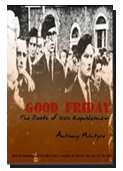 |
Ver página en español aquí.
Dr. McIntyre is a former IRA prisoner who spent eighteen years in the H-Blocks of Long Kesh Prison. He completed his Ph.D. upon release and has written extensively on Northern Irish politics.
|
Liam O Ruairc Reviews Good Friday for The Sovereign Nation ...The book is strong when challenging some of the dominant interpretations of the political developments of the last ten years and offering an alternative perspective informed by what the author believes are the core values of Provisional republicanism: “defence, defiance and dissent”. However McIntyre's contention that republicanism is a spent force is more debatable... While the book is a clear product of “defeat, decommissioning and disbandment”, it is much too early to say that it is the “death of Irish Republicanism”...Viewed from a longer historical perspective, it is possible to make the case that it could grow if the conditions are right. Until that moment what can be done? For McIntyre, repeating Vaclav Havel's call to speak truth to power and Milan Kundera's point that 'the struggle of man against power is the struggle of memory against forgetting'. The articles contained in this book are an excellent instance of speaking truth to power and a poignant example of “the awesome power of Republican memory to triumph over those who wish to forget what they inflicted and those who conveniently want us to forget what it was all about.”
—Liam O Ruairc
The Sovereign Nation
Sam Millar Weighs in on Good Friday for Verbal Magazine
When a book boasts a monumental declaration such as the death of Irish Republicanism, it had better stand up to scrutiny. And so it was with relish I tucked into Anthony McIntyre’s Good Friday, seeking not a full dinner, but at least some tasty morsels...Despite its academically-inclined leanings, readers should not be put off, as the book is compulsive reading and offers at times a very accessible insight to the key events and personalities which have shaped the contemporary history of the Republican Movement from the early 70s to present day. The book is most absorbing when it details happenings we think we’re familiar with: The Hunger Strikes, the brutal murder of Robert McCartney, Decommissioning, The Colombia Three, Stakeknife and, of course, The Good Friday Agreement. They are all there, critically analysed in a concise voice. At times the book reads like a Shakespearean tragedy peppered with Greek irony; other times it reads like The Diary of Samuel Pepys or Orwell’s prophetically brilliant Animal Farm...The author’s opinions will interest those looking for an alternative to the uncritical party voice of Sinn Fein, or those wishing to gain an insight into the machinations of life inside that organisation. Some within the breathing republican family will no doubt scoff at the idea of being classified as dead. Only time will tell if Doctor McIntyre’s grim prognosis of The Republican Movement is accurate or if, to paraphrase Mark Twain: its death has been greatly exaggerated, once again...Good Friday: The Death of Irish Republicanism is an important book, gripping, honest and revelatory, it’s one that probably will not find it’s way onto Gerry Adams’ must-read list. It should, however, be on yours.
―Sam Millar
Verbal Magazine
A Human Call for Justice and Truth
The Blanket's Seaghán Ó Murchú breaks it down for new readers of Good Friday.
As an ex-IRA "blanketman," already imprisoned in his teens, interned for 17 years at Long Kesh, Anthony McIntyre knows his subject by having lived most of his life as a volunteer. After prison, he earned a Ph.D. in political science at Queen's. This Belfast native collects various articles and interviews from the past decade or so that list the deathbed rattles and defiant ralliery of Sinn Féin, the IRA, and the the stalemated peace process after the 1998 Good Friday Agreement. The chicanery with which this deal was finagled to a rank-and-file previously misled about the continuation of their armed struggle led to McIntyre's break with the "Republican Movement" at least as constituted under the control of Gerry Adams, Martin McGuinness, and their devoted cadre.
Becoming a leading voice for those who disagreed, not for a return to the "physical-force tradition" but a renewal of the ideals which the IRA he and others joined had abandoned, Dr McIntyre combines two rarely encountered areas of expertise. As an insider, he betters the academics and reporters in relating the perspective of an Irish republican who's proven his credibility on the blanket. As a commentator, he's able to silence the "militant Republicans of the verbal type" eager to perch on barstools or boast to the naive their exploits, fueled with Dutch courage.
Admirably given his doctoral competence, McIntyre never lapses into jargon (although "etiology" escaped onto his keyboard once). He avoids sounding sanctimonious or overbearing. He, as with his model Orwell, manages to keep the human dimension within his sustained criticism of the IRA leadership that, for 320 pages, motivates his setting down-- with as much proof as can be summoned against an organization committed to double speak and clandestine councils-- the reasons why one can be principled, yet oppose the GFA packaged as "the peace process." Furthermore, he relates details to us in a calm, wry manner so that any newcomer can clearly understand the participants who support or oppose this intricate strategy.
It's a testament to his evenhandedness that one of the best moments comes when he's interviewing the chief of the reorganized Police Service of Northern Ireland (formerly the RUC), Hugh Orde. "It was the most I had ever talked in a police station," he admits. (282) While his sympathies remain throughout with the peaceful dissidents, he includes fair treatment of those later incarcerated from the splinter groups determined to fight for the cause abandoned--with considerable cynicism, spin, and rhetorical acrobatics--by the IRA leadership and Sinn Féin negotiators. Attention to the Loyalist perspective might have been welcome, but this anthology's already large enough. Counterparts to McIntyre or Ed Moloney's "A Secret History of the IRA" exist from the Unionist viewpoint. As the subtitle indicates, McIntyre's not providing a history of the past forty or hundred years in the North. He's analyzing the RM endgame itself, as a former player privy to many of the moves.
The book's organized into thirteen chapters. Each offers a few articles around a theme. I found the organization sensible, and there's an internal coherence that carries you from one topic to the next gradually, if subtly. An introduction by Moloney, whose own views have been met with the same vitriol accorded McIntyre's among the party faithful, but with equal recognition of insight by those less aligned, provides background on the policy shifts. A glossary clues you in to who's Ronnie Flanagan or what's the IMC.
This will be a long review, as the ones so far I've seen have not dealt with the contents in depth. They've focused more on the controversy of the author and his thesis. What's missing from such terse attention? The flair with which McIntyre conveys his passion-- and his sobriety. There's little autobiography, but he's dealing with a shadowy, fatal, yet publicized and romanticized cause to which he gave his youth, and much of his adulthood. Half of his life's in the H-Blocks. He leaves to find himself facing a different IRA on the outside than the one he'd sworn to defend decades before. From the mid-1990s on--along with like-minded volunteers, their families, friends, and comrades-- he's left to flounder while the party leaders posed for the cameras, accepted the acclaim, and betrayed the footsoldiers, those living and dead, those who had starved themselves to death rather than accept branding as common criminals.
One does not have to accept their methods of the proxy bomb, the guerrilla attack, or the torture of innocents to accept what McIntyre and those whose stories he tells believed in: a united Ireland that through their guns would be gained. They gave up their lives in total or a portion for such an ideal. This vision dimmed under the glare of their commanders who proclaimed a treaty that echoed that compromise which they had rejected in 1975. That was thousands of killings earlier. The confusion and outrage of those left fooled again becomes a human call for justice and truth.
Chapter 1 laments the GFA. McIntyre in 1999 conjures up the tale of the pickpocket who robs his prey while unctously soothing his victim: "your personal security is brilliant." SF strips their communal base of its pride while telling its gulled voters how they were "the most politicised people in Europe." (10) In Chapter 2, the ghosts of the Republican Dead return to haunt those investigating in 2004 the 1987 pre-emptive attack by the British upon an IRA mission at Loughall. This is one episode that may elude those less knowledgeable about such incidents. I'd have liked more attention to the moral conundrum underlying the Loughall inquiry. The larger question of how ethical should the state be in eliminating or sparing those who seek its overthrow, however, remains sadly all too contemporary.
Poignantly, McIntyre confronts this problem personally. With his toddler daughter, he visits Bobby Sands' grave, only to hear the girl chortle; thus in a small way's fulfilled Sands' prediction that the revenge of the Irish would be the laughter of their children. In this 2004 entry, "Padraig Paisley," this sometimes reticent reporter offers one of his most powerful admissions of the cost of the long war upon those who had invested their lives towards a different ending than the one now on offer from their former commanders. In Long Kesh, they followed a leader who turned on them once they were freed. "Were I to have suggested a course of action during my H-Block days that would lead republicanism to where it is today I would have found myself residing in a loyalist wing." (40)
The space given as Chapter 3 to the hazily explained 2002 mishap of the Colombia Three surprised me, but this episode foreshadows later IRA-SF debacles in the Northern Bank Robbery and the fatal stabbing of Robert McCartney. It remains a muddled area; the murky accounts at the time show the difficulty in separating dirty deeds by the IRA's left hand from SF's right hand. When Adams is charged by Congressman Henry Hyde to "'appear and help us determine what the Sinn Fein leadership knew about the IRA activities with the FACR narco-terrorists in Colombia and when did Sinn Fein learn of them', it was clear that the knotted tie of the IRA was being moved uncomfortably close to the party windpipe." (50) The ten years of witnessing the RM's downhill slide proves grimly amusing, from this perspective.
Decommissioning magnifies the microcosm of the Colombian misadventure for global inspection. Not as a symbol, but as fact: giving up IRA arms dumps means the conflict's truly ended. 2001: As the leaders, pushed back from their goal of a unified Ireland into capitulation keep retreating and calling it progress, "they are moved muttering from one slain sacred cow to defend another before it too is slaughtered." (64) 2002: Those like him who complain will incur blame for raising their heads out of the trenches, where "they would immediately draw the attention and surveillance of thought traffic control and the fire of the verbal snipers, their weapons loaded with vitriol, eager to impose silence and prevent republicanism from becoming more democratic." (71)
Long before 2003, McIntyre's disgusted at "organised lying by organised liars. Half a century from now pilgrims, patriots, and prevaricators will flock to the graves of the Provisional Republican leadership to be greeted by an inscription meticulously inscribed into a headstone: 'Here they are-- lying still'." (78)
Cemeteries in West Belfast already fill with those who went to their graves believing in a patriotism that their leaders had, in secret, already abandoned. McIntyre has both outgrown his youthful enthusiasm and managed to nourish his righteous ideals. These matured, I would suggest, from the Fenian slogans of his teenaged years into a humanist skepticism towards totalitarianism in any form, however benignly promoted or however applauded by the chattering classes. He resists the cult of personality that has eclipsed the democratic socialist Republic of 1916.
Chapter 5, most notably with a twenty-page 2006 interview with fellow ex-blanketman Richard O'Rawe, delves into the difficult matter of how much Adams knew when in charge of part of the IRA contigent in the H-Blocks during the second hunger strike that left ten men dead in 1981. O'Rawe's "Blanketmen" book's claims are balanced by outside sources which both men carefully cite in their cautious yet charged dialogue. They explore O'Rawe's argument that Adams deliberately withheld information to advance SF electoral fortunes, rather than intervene with proposals relayed from British negotiators that could have ended the strike, thereby saving the last six men from self-starvation.
A quarter-century later, McInytre speaks at Bundoran to those who shared the years on the dirty protest. Addressing those who now oppose his own dissidence, he manages to affirm his own position while remaining respectful to his detractors. He defends O'Rawe, and reminds his comrades that the rumor-mongering against O'Rawe (and himself by extension) does the 1981 commemoration no credit. He paraphrases the press who lambasted the SF rally (with blankets sold to marchers) to commemorate the ten men dead "as resembling a Friar Tuck convention more than the austere era of the Blanket protest and hunger strikes. The contrast between the easy corpulence of today and the hard emaciation of twenty-five years ago was no more stark than it was on the Falls Road at that political rally. In a sense the imagery mirrored perfectly the ethical decay that has come to beset republicanism. The screws at least gave out the blankets for free." (115)
Suppressing Dissent, as Chapter 6, continues in similar tone. McIntyre allows us to hear more stories from those who speak out against party lines, and in West Belfast, who suffer for their rebellion. Brendan Shannon, "Shando," sticks to his guns as a proponent of the armed struggle. While McIntyre regards him as a cautionary tale of the true believer left stranded, he treats him with dignity and in 2003 tells his story honestly. In 1995, Shando explains to McIntyre: "I did not leave the Provos because they gave up the war. I left because they gave up republicanism." (139)
One who did not survive in early 2005 after standing up against the system, Robert McCartney, merits Chapter 7. His murder, along with the Northern Bank and Colombia 3 incidents, further tarnished an already dulled Sinn Féin. McIntyre and his wife ran the e-zine "The Blanket" 2001-08. They refused to back down to SF militia. They were harassed, raided, and intimidated. Most of the entries in this book originated with their grassroots Net campaigns on behalf of their cowed neighbors and harangued colleagues. They display to future historians and activists the birth of Web networks married to practical activism. This harnessed solidarity for practical gains rather than arcane monographs on republican community organizing.
These chapters also reveal McIntyre's growth as a more generous participant in his changing Irish reality. He almost encourages a PSNI officer with "good luck" as the police try to find Bert's killers. As one with his ear to the ground, McIntyre knows at least one culprit even if he's not charged directly. "IRA culture was drawn on heavily both to inflict the crime and to cover it up," (173) even if hard proof dissolves into soft supposition and perhaps a bit of brass knuckles on any witnesses out of the dozens of people who saw the fatal assault-- unless they were all as they claimed in the pub's jakes. The party interferes, so no allegations of collusion between the supposedly rogue IRA operators and the SF can be sustained in court.
This leads to frustration. How can you fight such an implacable machine? Others join in the protest, but against those who complain. They defend Adams and McGuinness. Why do McIntyre and his colleagues oppose what so many voted for, North and South? The Loyalist veto's consented to by SF. The IRA surrendered. The Crown rules as long as most Northerners agree to a British ruler. McIntyre counters that "the process subverts the peace." (168) Many who favor cessation of violence do not assent to the process, he argues. Their disagreement with the GFA, moreover, remains non-violent. Meanwhile, the IRA and SF subvert the community they claim to advance-- with thugs, censorship, and discrimination.
Informers, long the republican's bane, now turn into its own agents of destruction. Freddie Scappaticci, "Stakeknife," and Denis Donaldson gain infamy. McIntyre's clever. He asks nimbly what Donaldson as a British agent did that Martin McGuinness as a British minister at Stormont did not. Both "shaft Republicanism." Rumors persist, and seem to be hushed, about IRA spies even higher up than Donaldson. The author knows the pressures that burden those volunteers fresh out of prison, unable to cope. "The choice was simple: Grow old and grey with imprisoned comrades and wake up alone each morning to the sound of clanging grillsl or come to beside a partner and to the laughter of children." (191) While never excusing what Stakeknife or others did by betraying their cause, McIntyre as an ex-prisoner and as one who has worked with many others like himself captures what few other writers could have expressed about the personal torment that a few of his weaker colleagues endured for decades as they fought, talked, and confided in comrades whom they would expose to their own compromise, or often death at the hands of killers within the IRA as well as among the Loyalists and British forces-- whether vetted or below the radar.
McIntyre's also compassionate towards the reputation that shrouds their children and grandchildren; he implies how this character assassination may be the worst crime yet hatched by such informers. "Provisionalism is being haunted by a spooky spectre," he confides in 2005. "What blossomed in spring has now become autumn fruit, as poisonous as it is bountiful." (193)
With Chapter 9, Comrades appear. These too have been weighed down by compromises when they emerged from prison. The late Brendan Hughes in 2000 tells McIntyre: "We fought on and for what? What we rejected in 1975." (198) A leader of the H-Blocks during the strike, on release he found himself cheated by building crews in West Belfast where he worked; those who were his bosses justified their hypocrisy by their ties to the cosy SF leadership. Exposing this immorality, he found himself expelled by those whom he once had commanded and respected. He concludes how the "Republican leadership has always exploited our loyalty." (200)
In 2006, "Granny Josie" Gallagher remembers when she visited her three sons, all jailed at Long Kesh, over twenty-two years. Two were in the Marxist INLA. Thumbing a ride in the snow on the way back from her prison visit, the Sinn Féin transport van refused her a ride. If she was at the H-Blocks to see her third son, in the IRA, than she might have earned a ride. Such was the discrimination and pettiness even within the IRA, as McIntyre rues now.
For Dissembling, Chapter 10, McIntyre covers critics of SF-IRA groupthink. In 1994, when the cease-fire was declared, McIntyre was with his comrade Tommy Gorman when Gorman called to agree with Bernadette McAliskey on BBC's "Talkback" with her comment that "the war is over and the good guys lost." (226) From that point on, they and others discussed in this chapter found themselves the targets of the SF-IRA disinformation operatives. Their names were discredited, their supposed links to the militants were publicized, and their credibility was attacked. What differs between the tactics of any faction who has gained power in a putsch? Perhaps the fact that the leaders had led on the followers for so long, so fatally, while dissembling.
With the 2004 Northern Bank robbery in Chapter 11, there's not much point even pretending. "If, as has been widely alleged, the robbery is the work of the Provisional IRA's Army Council, then it is a matter of the rich robbing the rich." (254) Policing, in Chapter 12, finds SF in a quandary. Having lost the hearts and minds of those in projects such as Ballymurphy (where McIntyre had lived when writing these articles), the RM could not provide the protection the residents needed. Over nine months in 2006, 700 acts of violence or intimidation had occurred in his neighborhood. The collapse of the community, as former republican ideals to rally solidarity eroded under drugs, teen pregnancy, vandalism, and theft, showed another collapse of Irish idealism under British administration. The PSNI had first been castigated by republicans, and then clumsily courted, but this left the locals in an awkward situation of who to call on for help. The PSNI wearied, the IRA devolved into a gang, and with few arrests amidst the grim scenario, the costs of the long war's slide into a restless temper tantrum of dealing and dissing showed how hollow had been the claims of a peaceful Northern Irish settlement for so many in what had been Gerry Adams' heartland, his base for IRA action and SF allegiance.
Strategic Failure, fittingly, concludes this book as Chapter 13. It includes the visit to Orde. What do republicans and dissidents do when the system's in place and the Loyalists remain in control with the consent of the nationalists, post-GFA? Learning to get along, in power or driven away from the dream of centuries of Irish men and women who fought and died for unification, republicans today may be the last of their line so bred to never give up the battle in every generation. Post 9/11, the lust for the brawl's faded. McIntyre's post-mortem for Moloney's 2003 castigation of the hypocrisy of the Adams-McGuinness leadership finds its eulogy repeated in his own compiled arguments here. "For those of us who sought a different and a better outcome-- more just, more egalitarian, more democratic, more honest-- read it and weep." (308)
One does wonder--admittedly lacking the personal experience that informed the rationale of McIntyre after so much of his life fighting the British state-- if the author should blurt out what he locks inside. Why not, locked inside for so long, as an ex-prisoner demonstrate your inner liberation? Why not embrace your local peeler?
Frequent criticism levelled at dissenters has been that in their refusal to change, they stand for the corrosive qualities of a discarded republicanism that will not survive long into our own century. McIntyre and his comrades raised their own voices against those who drowned them out in the mainstream media most nights. They persisted despite direct and disguised attempts to shut them up. They refused to submit to those who had betrayed them; they turned away from those who beckoned them back to a useless fight. This collection offers carefully reasoned articles insisting that another form of purer republicanism still lingers that deserves resurrection. "The Blanket," as an aside, often featured spirited debate about this very issue, although the selection of more topical pieces by McIntyre may tilt his own anthology towards a clearer chronological, thematically cohesive presentation.
Perhaps, given the futility of the hardline remnant of compromised and infiltrated militants and the corruption of co-opted SF, any "third way" here appears a glimpse up a foggy cul-de-sac. McIntyre and Moloney convince you that the ground troops in the Fenian campaign have been betrayed, but like the Wild Geese, one now wonders what cause will answer their ambitions. Will those who visit the graves in fifty years look back on today's dissidents as students may skim the manifestoes from the ralliers for the restoration of Bonnie Prince Charlie or the Bourbon dynasty?
The failure of an alternative movement to counter the party machine resulted, eventually as this anthology silently documents, the folding up of "The Blanket" earlier this year. Its purpose appeared to have been finished; other community activists had taken up the watch, the governments had agencies in place, and the criminal activities that had replaced the RM with petty theft, drug running, and slum squalor appeared less the blame of the Brits and more the lassitude of post-GFA residents. The tricolor flutters and the strikers commemorated on murals still grace the closely packed streets, but one wonders if these depictions will in time fade into "tradition" as walls in other redoubts, those post-GFA Unionist enclaves. The whitewashing waits. McIntyre's anthology warns us of the impermanence of what once stood as an unshakeable foundation under any republican, dawn over a unified island.
―fionnchú.blogspot.com
|
"McIntyre...long ago decided that an all-Ireland republic should not be pursued through violent means...In Good Friday...he concerns himself with the reasons the Republican leadership gave for abandoning the struggle... 'When did the securing of equal rights for Catholics... replace the dream of a 32-county socialist republic?' he asks."
—David Adams Irish Times
"When McIntyre wrote all this...he was scorned and ridiculed...The passage of time has brought vindication..."
—Ed Moloney
author of A Secret History of the IRA
"...When future historians come to write about the period between 1969-2005, McIntyre's book will be essential reading, for he was amongst the first to realize that the entire northern Irish peace process was orchestrated by synchronized lying..."
—Mick Hall
writer of Organized Rage
"For historians and other journalists, the writings of Anthony McIntyre are an invaluable resource...No future histories of the period and the process will have any credibility if they don't draw on it."
—Malachi O'Doherty
author of Empty Pulpits: Ireland's Retreat from Religion
"A fascinating insight into the politics of the six north eastern counties of Ireland...To not have this book on your 'Irish' book shelf is to have an incomplete understanding of the Belfast Agreement, alias, the Good Friday Agreement."
—Joe Graham Rushlight Magazine
"Through McIntyre's book I've come to better understand how the British managed to neutralize Irish republicanism...money, big salaries and important positions await those who have a price. In Puerto Rico as in Northern Ireland... whatever traces of republicanism remain are much better defined as 'collaborationism.' " —Dr. Ovidio Dávila, Ex Director del Programa de Arqueología y Etnohistoria del Instituto de Cultura Puertorriqueña
|
|
|
|